
Whenever I design any learning experience, I am trying to incorporate a lot of diversity and novelty – to accommodate for all sorts of learners and keep their attention long-term.
As educators, we need to be mindful that our learners may have permanent (someone struggling with a complex text) or other (being really tired in synchronous class) limitations.
That means that Modern Lawyers happen in multiple formats – from traditional readings to podcast.
The following is a reflection on the introduction of a new dimension: video.
The Brief
The whole process started when I identified the need for deeper introduction into technologies that are not traditionally used by lawyers, such as Figma and Canva.
I would usually share tutorials made by others, but none of them were set in legal context. And the combination of dual challenge: new tech tool in an unfamiliar setting proved to make these ineffective.
This popped up in the student feedback, both in written questionnaires and informal discussions.
Videos seemed to be the perfect fit to address these needs because:
- It would not make sense to dedicate time to these topics in class
- A full explanation requires both audio and visuals
- Not every student needs these, as some already have extensive knowledge of these tools or choose to use other ones
I discussed this observation and the plan with my students during a codesign workshop. I received encouragement on this idea – with the caveat that the videos have to be actionable, with clear benefit for the class, and, above all else, not terribly long.
First prototype
I did not have any support system for doing videos. No hardware, no software.
But for the first prototype, which was mostly intended to validate my assumptions, no fancy tech was necessary. Instead, I did a mashup using MS Teams and iMovie.
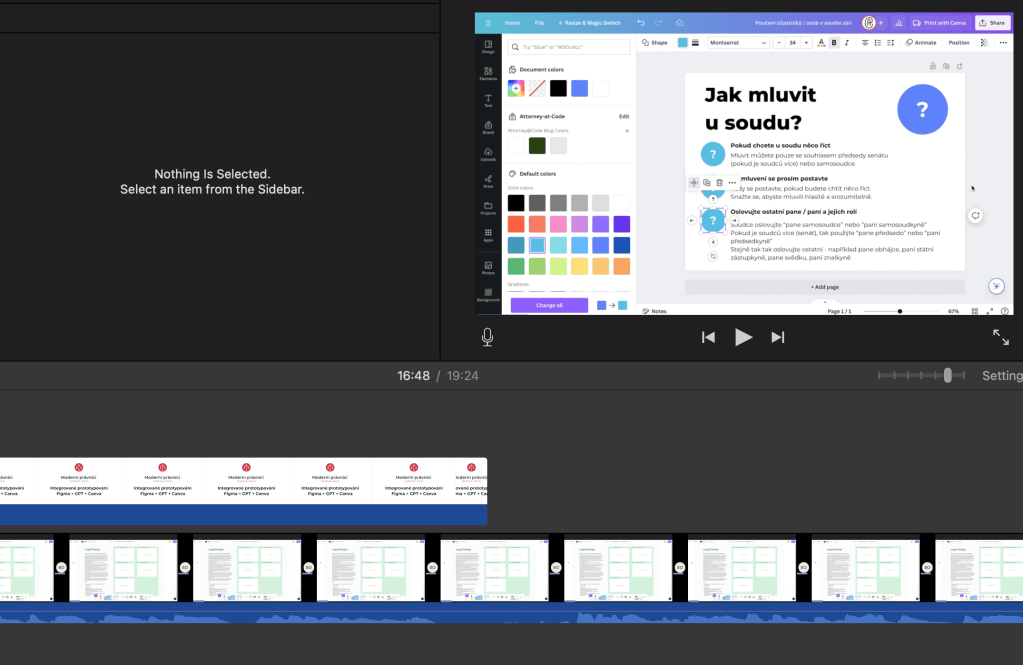
I chose two distinct prototypes: one to illustrate the design of static and one for dynamic legal information.
- Static legal information: I chose the document with the instructions that are in front of every Czech courtroom
- Dynamic legal information: as an interactive feature, I recorded the process of making a prototype of merger approval chatbot
In the videos, I covered:
- Figma – I use a FigJam as interactive dashboard for the entire semester, for communicating and collecting assignments,
- Canva – selected for ease of use and decent free version
- GPT – for its data-processing capabilities
First feedback
I shared the videos with my students, the alumni who attended the codesign workshop, my mentor, and a some legal design friends.
I collected feedback from students in the next class, which was about 5 days after I shared these. By then, only about a third of the students watched the videos. And that is ok, because:
- the point of making asynchronous content is that students can refer to it asynchronously
- having more options mean more impact overall, even if specific learning content receives less views
- the students have their own lives and sometimes just don’t have the time
The feedback from the students and everyone else who did watch the video was very positive.
Some notes from this process
Structure and standards
Based on the first two prototypes, I decided to codify some of the structure that I can rely on in the next ones:
- Introduction: welcome the students, state the learning objectives
- What tech we will be using
- The content itself
- Thought provoking questions and follow-up project prompts
Next videos
I made the videos and I did not watch them for a while, as the semester progressed and I needed to focus on other bits of the learning experience.
When I rewatched the videos a couple months later, I had a fresh perspective, and concluded the following:
- The audio needs to improve (anyone got recommendations for mics?)
- The videos need to get shorter (I watched it in 2x speed and got a little bored by the end)
- The narrative arch needs to be clearer and with emphasis on how each one of the learning can be used in practice
I have prepared a revamped version implementing the learnings from the first prototype.
This is yet to be tested, as I want to afford myself some time before I rewatch them again.
Final notes
The prototypes helped me validate my assumption that videos could have added value to the class.
I had a lot of fun making this new format and learned so much.
But I am also humbled by how much work it is to make decent video content. I do spend quite a bit of time learning on YouTube, so this experience left me with even heightened appreciation to my favorite creators.
Baru
 Baru Obračajová
Leave a comment