
The key foundation of futures studies is that there is always a broad range of futures.
This makes the field incredibly intriguing, and also fairly inexhaustible, which makes me, frankly, fairly excited.
Therefore, my overarching learning goal is to explore more and more of it and weave theory and practice.
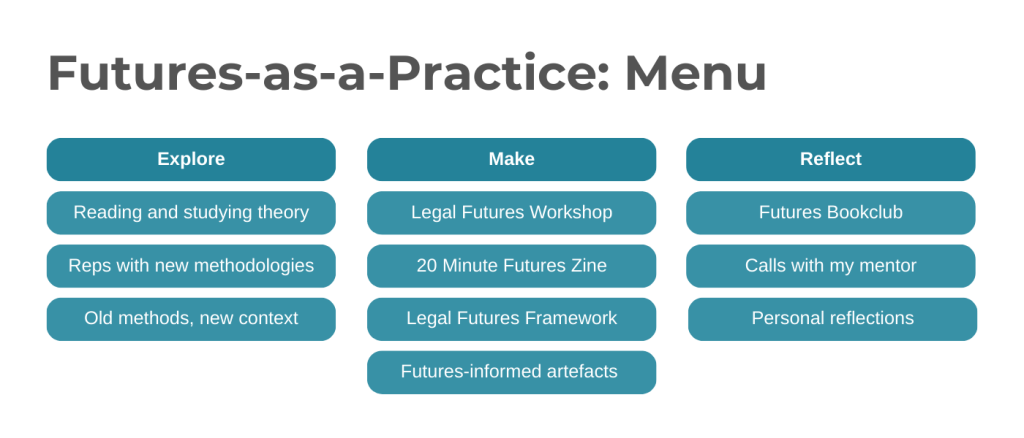
Below is a curated list of what I found useful in my journey in the past few months as a futurist and designer. I have been doing a lot of futures work, so this will take you about 5 minutes to read.
Reading list
There are plenty of inspirational resources in the futures studies and design futures space, so I made a reading list that I am slowly but surely digesting.
A good futures diet in my opinion consists of a good mix of methodology and (design) fiction. Think about it as process and substance in law – one gives you the framework, and the other one something to dissect.
You can find my recent favorites in this post, with Designing Futures by Benedikt Groß and Eileen Mandir being my absolute favorite.
Beyond that I like to reach for The Manual of Design Fiction (Near Future Laboratory), Assembling Tomorrow (Scott Doorley, Carissa Carter), and the works of Sohail Inayatullah.
Introducing new methodologies
Lately, I have been approaching methodologies like dance moves.
I try it out, attempt it a first time in a safe space, and then bring it onto the dance floor, when the music and vibe are right.
For example, I have been obsessed with using continua to stretch and explore multiple futures scenarios. I got a few reps in on smaller projects first, and now I am using it everywhere. Continua help expand the design space, explore different angles of design challenges, and challenge basic assumptions around products.
Second methodological approach that has my feet moving is linear regression and criteria assessment. I have been doing a lot of scoring sheets for my ideas and designs, turning the evaluation into a more transparent experience.
In short: doing the reps.
Introducing old methodologies to new contexts
Alongside trying new methodologies, I have also been exploring much wider use of existing approaches on new types of problems.
Gradually, I realized that I have been using futures artefacts in all sorts of design processes.
This included:
- using diegetic prototypes to explore initial reactions to ideas,
- writing an ideal case future scenario as a first step of any project to establish a North Star,
- concluding a research with artefacts, not just text of outputs,
- establishing an assemblage space for a project to map out the links between futures, past, and present
- whipping a quick interface with Lovable or v0 to illustrate a point or explore an idea.
This completely redefined the (artificial) distinction between design thinking and speculative projects.
The process became futures-informed design.
Making Practice
All the theory makes the most sense to me in the context of making.
When I translated the frameworks into actual design decisions, icons, and learning plans, the whole practice gained a completely new meaning.
I incorporated futures into multiple design prototypes, which include:
- A Legal Futures Workshop (stay tuned)
- A TWENTY MINUTE FUTURES Zine, which explains the very basics of futures studies in a quick and snappy fashion
- Legal Futures framework and methodology
- Many prototypes, artefacts, and provotypes within other design projects
In particular, I used the TWENTY MINUTE FUTURES zine to facilitate a workshop at Masaryk University. In 20 minutes, the participants (students of Information Services Design) learned what are signals, defined and categorised multiple futures, and got a light layer of futures methodology. I was feeling vulnerable, introducing my very first paper prototype to a big group.
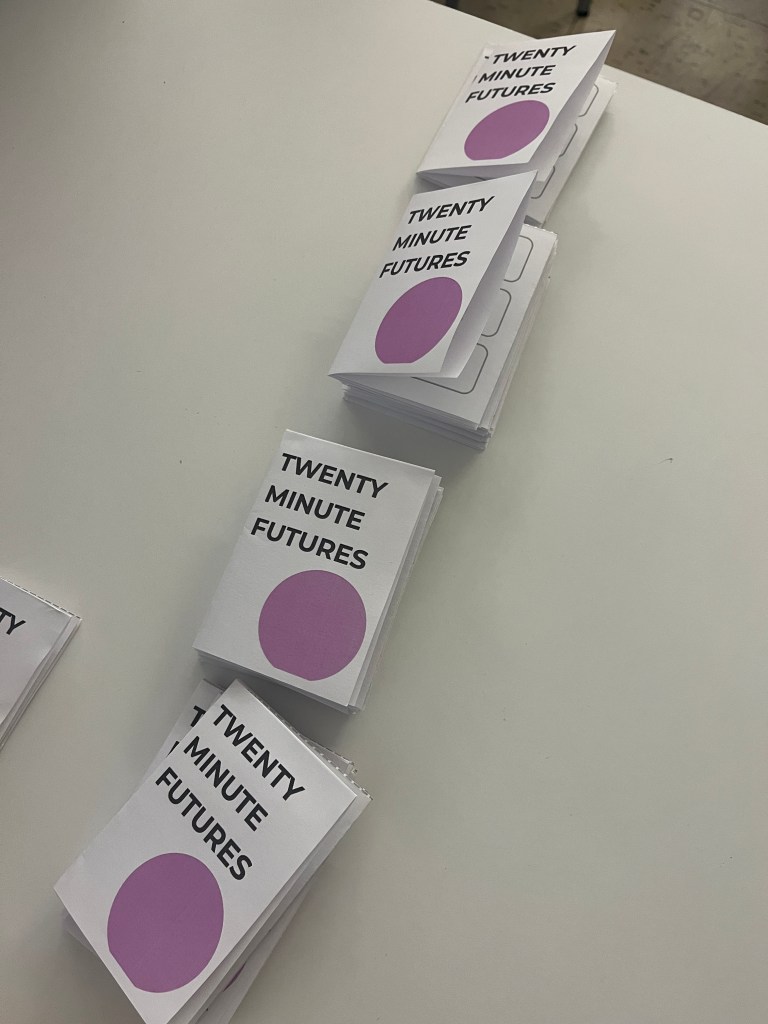
The feedback was overwhelmingly positive. It gave me a huge boost in confidence, and frankly, made me tear up a little.
I intend to continue to dedicate meaningful chunks of time to both theory and practice. Going back and forth between the two ensures both: informed use as well as keeping depth in the process.
Reflective Practice
None of the above would make any sense, if not coupled with an intentional reflection on both individual and collective level.
Personally, I write a quick reflection after every sprint in the format of what, so what, now what. This helps me distill my impressions as well as actionable steps for the next one.
Nevertheless, my absolute favorite was discussing futures with a few of good design friends and my mentor, and I would love to keep the conversation going. It was a highlight to compare our approaches across disciplines, share resources and reading lists, and have a few inside futures jokes running in our little (and growing!) circle.
I have a feeling that this is becoming a Futures Bookclub.
Upcoming Futures
In my futures, there are more workshops, more projects, and more making.
All this work means that I have been establishing a specific legal futures framework that works across legal innovation and design projects.
This has been improving efficiency and the landing of the ideas and solutions. I will be iterating on the framework and testing it with more and more users, actors, and contexts.
As a steward of carrying over futures and design methodologies, a key concern is combining the best of both into a tailored process that will reflect the idiosyncrasies of the legal system with the intellectual space of the futures studies.
This has been such an organic and seamless process that I have been feeling at home with.
See you in the futures,
Baru
 Baru Obračajová
Leave a comment